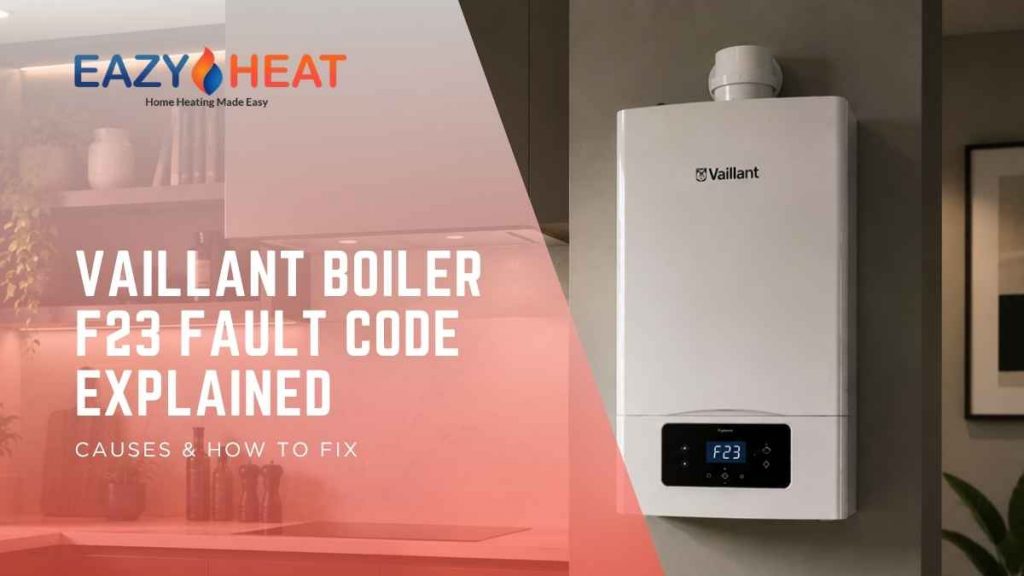

The F23 fault code is a safety message that appears when your Vaillant boiler detects an unusually large temperature difference between the hot water leaving the unit (the flow) and the cooler water coming back (the return).
In simple terms, the water is getting much hotter on the way out than it should relative to what returns, often more than about 35°C. Your Vaillant boiler shuts down to protect the heat exchanger and other parts from possible damage.
This code is common on many ecoTEC models used in UK homes and by landlords, and it usually points to a circulation problem somewhere in the heating system.
What Does The Vaillant Boiler F23 Fault Code Mean?
The Vaillant boiler F23 fault code means the temperature spread between the flow and return sides of the boiler has become too great. Your boiler constantly checks these two temperature readings using sensors. When the gap grows beyond the safe limit, it stops working as a protective measure.
You might see the heating cut out, radiators stay cool, or the display shows F23 or F.23. It does not always stop hot water on a combi, but it does interrupt central heating. Vaillant lists this as a safety switch-off linked to flow and return temperature sensors and circulation issues. Understanding this helps you know why the boiler is acting up and what to check next.
What Causes The F23 Fault Code On Your Vaillant Boiler?
The F23 fault code on your Vaillant boiler is usually triggered by poor water circulation that creates a big temperature gap between the flow and return pipes. The most common reasons include sludge or blockages restricting flow, a weak or failing pump, trapped air, or problems with the temperature sensors themselves.
These issues are frequent in older systems or hard-water areas across the UK.
Below we break down each main cause in plain language and show practical steps to fix them. Always remember that gas and boiler work beyond basic checks needs a Gas Safe registered engineer.
Blocked Or Sludge Filled Heating System
A blocked or sludge-filled heating system is one of the top reasons for the F23 error code. Over years of use, black iron oxide sludge and limescale build up inside radiators, pipes and the heat exchanger. This muck slows or stops water moving freely.
The water inside the boiler keeps getting hotter while cooler water struggles to return, creating the large temperature difference that triggers the fault. You may notice cold spots at the bottom of radiators, noisy pipes, or the system taking longer to warm up. Hard-water regions in the South East and London see this more often.
Left alone, sludge can damage the heat exchanger and shorten the life of the whole system.
How To Fix
- Check your radiators for cold spots at the bottom while the heating is on. This often signals sludge.
- Try bleeding the radiators carefully to see if any dirty water comes out.
- Arrange a professional power flush with a Gas Safe engineer. This uses a special pump and chemicals to clear the system thoroughly, usually taking several hours depending on the size of your home.
- After the flush, ask the engineer to add a good quality inhibitor and fit a magnetic filter if you do not already have one. This helps stop sludge building up again.
- Book an annual service to keep the system clean and catch problems early.
A typical power flush in the UK costs between £350 and £800 depending on the number of radiators and how dirty the system is.
Faulty Or Weak Circulating Pump
A faulty or weak circulating pump is another frequent cause of the F23 fault. The pump is responsible for moving hot water around your radiators and back to the boiler. If it runs too slowly, seizes, or is set on a low speed, water stays in the boiler too long and overheats on the flow side while the return stays cooler.
You might hear unusual humming or grinding from the boiler area, notice uneven heating, or find that the fault appears mainly when the heating is calling for full power. Pumps wear out over time, especially in systems that have never been flushed.
How To Fix
- Listen carefully near the boiler when the heating is on. Unusual noises can point to a struggling pump.
- Check that all radiator valves and any isolation valves under the boiler are fully open.
- Reset the boiler according to your handbook to see if the fault clears temporarily.
- Call a Gas Safe registered engineer. They will test the pump speed setting, check the capacitor and either adjust or replace the pump.
- Ask them to confirm the system is free of sludge at the same time, because debris often damages pumps.
Pump repairs or replacements typically form part of the average UK boiler repair cost of around £300, though parts and labour can push it higher.
Trapped Air Or Airlocks In The System
Trapped air or airlocks in the system can easily trigger the F23 code. Air pockets stop water circulating properly, so some parts of the system heat up while others do not. This creates the temperature imbalance the sensors detect.
Air often enters after radiators have been drained, after a recent repair, or if the system pressure has dropped. You may hear gurgling sounds from radiators or pipes, or notice that some radiators stay cold at the top.
How To Fix
- Turn the heating off and let the system cool.
- Bleed every radiator starting from the lowest floor and working upwards, using a radiator key. Hold a cloth ready to catch any water.
- Check the boiler pressure gauge afterwards. It should sit between 1.0 and 1.5 bar when the system is cold. Top up carefully using the filling loop if needed, following your boiler instructions.
- Restart the boiler and see if the F23 clears.
- If the fault returns or you find the pressure drops again quickly, contact a Gas Safe engineer. They can check for ongoing air entry points or larger airlocks inside the boiler itself.
Faulty Flow Or Return Temperature Sensors
Faulty flow or return temperature sensors (sometimes called NTC sensors or thermistors) can cause the F23 error even when circulation is fine. These small sensors clip onto the pipes inside the boiler and tell the control board the exact temperatures.
If one fails, the wiring becomes loose or corroded, or they were connected the wrong way round during a previous repair, the boiler receives incorrect readings and shuts down for safety. This issue is less common than sludge or pump problems but still appears regularly on ecoTEC models.
How To Fix
- Do not attempt to open the boiler casing yourself. That work is for qualified people only.
- Note whether the fault appears at the same time every day or after certain heating demands.
- Contact a Gas Safe registered engineer who is familiar with Vaillant boilers.
- The engineer will test the sensors with a multimeter, check the wiring connections and replace any faulty sensor.
- Ask them to verify that the sensors are correctly positioned and that the rest of the system is circulating properly.
Sensor replacement is usually a straightforward job once the engineer is on site.
If the F23 fault code keeps returning after these checks, the underlying system may simply be reaching the end of its reliable life. Continuing to repair an ageing boiler can become more expensive than upgrading.
A modern high-efficiency boiler often cuts energy use and comes with a long manufacturer warranty, giving both homeowners and landlords peace of mind.
How Can You Prevent The Vaillant Boiler F23 Fault Code In Future?
Preventing the F23 fault code starts with regular care of the whole heating system. Book an annual Gas Safe service so an engineer can check the pump, sensors, pressure and inhibitor levels. Fit a magnetic filter if you do not have one already. This catches sludge before it reaches the boiler.
Bleed radiators whenever you notice cold spots or gurgling. Keep system pressure in the correct range and avoid letting the system sit unused for long periods without an inhibitor. In hard-water areas, consider a scale reducer. These simple habits keep water flowing freely and reduce the chance of large temperature differences appearing.
Stop Recurring Vaillant F23 Faults with a New Energy-Efficient Boiler
If your Vaillant boiler keeps displaying the F23 fault code, it could be a sign of ongoing circulation problems, sludge build-up, or ageing internal components. While some faults can be repaired, repeated breakdowns often become more expensive than replacing the boiler with a modern, reliable alternative.
At Eazy Heat, we make upgrading your boiler simple. We provide professional boiler installations for homeowners and landlords across the UK, with every installation carried out by experienced Gas Safe registered engineers. You’ll also benefit from a market-leading 12-year parts and labour warranty, giving you complete confidence in your new heating system.
Using our online boiler quotation tool, you can receive a clear, fixed-price quote in just a few simple steps. We’ve removed the stress from replacing your boiler, making it quick and straightforward to arrange a professional installation with minimal disruption.
If recurring F23 faults are leaving you without reliable heating, get your free online boiler quote today and discover how affordable a modern, energy-efficient boiler can be.
FAQs
Can the Vaillant boiler F23 fault code appear only when running hot water or baths?
Yes. On some combi models the extra demand can highlight circulation limits or sensor sensitivity, so the code shows mainly during high hot-water use. An engineer can check whether the pump or heat exchanger is struggling under that load.
Is the F23 fault covered under a Vaillant warranty?
It depends on the age of the boiler and the exact cause. Manufacturer warranties usually cover parts failure within the stated period, but sludge-related or system circulation problems are often classed as installation or maintenance issues and may not be covered. Always check your paperwork and speak to a Vaillant-approved engineer.
How long can I safely leave an F23 fault before calling an engineer?
You should not leave it. The boiler has shut down for safety. Running it repeatedly by resetting can stress the heat exchanger. Arrange a Gas Safe visit as soon as possible, especially in cold weather when heating is essential.
Does a landlord have extra responsibilities if a tenant reports the Vaillant boiler F23 fault code?
Yes. Landlords must keep the heating system in safe working order under UK law. Prompt investigation and repair by a Gas Safe engineer is required. Document everything and consider whether a full replacement is the more reliable long-term option for the tenancy.
Will fitting a magnetic filter stop the F23 code coming back?
A magnetic filter helps catch metal particles and sludge before they reach the boiler and pump. It greatly reduces the chance of future circulation problems when combined with a clean system and inhibitor, but it cannot fix an already failed pump or sensor on its own.