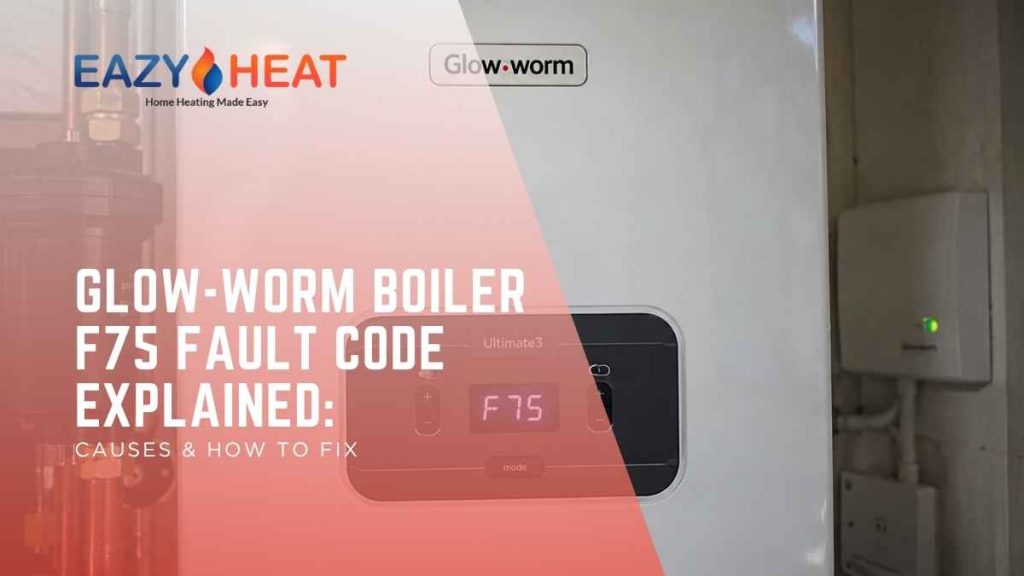

The Glow-Worm boiler F75 fault code means the boiler cannot detect a rise in water pressure when the circulation pump starts, so it locks out for safety. This stops both heating and hot water until the issue is resolved. It is a common circulation and pressure sensing fault on Glow-Worm models and the closely related Vaillant range.
This guide explains the meaning of the code in plain language, walks through the main causes, and sets out clear steps you can take safely. It also shows when professional help is the sensible next move.
What Does the Glow-Worm Boiler F75 Fault Code Mean?
The Glow-Worm boiler F75 fault code means the control board has not received confirmation of a pressure increase after the pump begins running. In normal operation the pump starts, water begins to move around the system, and the pressure sensor registers a small rise.
If that rise is not detected, the boiler shuts down and displays F75 to protect the appliance. You will usually see no heating or hot water, and you may hear the pump attempt to start or notice unusual noises such as humming, vibrating or gurgling.
The code does not always mean one specific part has failed. It simply tells you the expected pressure change is missing. Glow-Worm and Vaillant share this code, so the same diagnosis applies across both brands. Persistent F75 faults often point to sludge, a worn component or low system pressure that needs proper attention rather than repeated resets.
When an older boiler keeps showing the same pressure related error, the cost of repeated call-outs can add up quickly. Many homeowners and landlords find that a modern replacement boiler offers better reliability and lower running costs over time. Eazy Heat provides new boiler installations across the UK and can help you weigh the numbers for your property.
What Causes the F75 Fault Code on Your Glow-Worm Boiler?
Several common issues can trigger the F75 fault code on a Glow-Worm boiler. The most frequent are a blocked or faulty pressure sensor, a problem with the circulation pump, airlocks or sludge restricting flow, and low system water pressure. Below we look at each main cause and the practical steps that follow.
Faulty or Blocked Pressure Sensor
A faulty or blocked pressure sensor is one of the leading reasons for the F75 fault code. The sensor monitors water pressure and reports changes to the control board. Over time the narrow sensing channel can become restricted by magnetite sludge, limescale or general debris that builds up in the heating system.
Electrical failure inside the sensor can also stop accurate readings. When the sensor cannot detect the pressure rise that should occur as the pump starts, the boiler locks out even if the rest of the system is working.
How to Fix
- Check the pressure gauge on the boiler. Note whether the reading changes at all when the pump tries to start.
- If the pressure is below 1 bar when the system is cold, carefully repressurise to between 1 and 1.5 bar using the filling loop, following the instructions in your user manual.
- Reset the boiler once by holding the reset button for around five to ten seconds.
- If the F75 returns, stop further DIY attempts. A Gas Safe registered engineer can remove, clean or replace the pressure sensor. Cleaning the sensing channel often restores function, though replacement is sometimes required. Typical costs for sensor work sit in the lower range compared with major components.
- Ask the engineer about the condition of the system water. A power flush or magnetic filter can reduce the chance of the same blockage returning.
Faulty or Seized Circulation Pump
A faulty or seized circulation pump stops water moving properly around the system and prevents the expected pressure rise, triggering the F75 code. The pump can wear out after years of service, develop airlocks, or become restricted by sludge.
You may hear weak humming, vibrating or no sound at all when the boiler tries to start. Pumps commonly show problems after seven to ten years of continuous use in typical UK homes.
How to Fix
- Listen carefully when the boiler is called for heat. Note whether the pump makes a normal running sound, a weak hum, or remains silent.
- Bleed the radiators to remove any trapped air and then repressurise the system to the correct level.
- Reset the boiler once and observe the result.
- If the fault persists, call a Gas Safe engineer. They will test pump operation, check for blockages and replace the pump if needed. Pump replacement on most Glow-Worm models typically costs between £180 and £380 including labour, depending on the exact model and local rates.
- Consider having the system cleaned at the same time, as sludge is a frequent contributor to early pump failure.
Airlocks or Sludge in the System
Airlocks or sludge in the heating system restrict water flow so the pressure sensor never registers the rise the control board expects. Air can enter during recent radiator bleeding, repairs or if the expansion vessel is not working correctly.
Sludge (black magnetite debris) builds up gradually in radiators, pipework and the boiler itself, especially in systems that have not been flushed for several years. Both create the same F75 symptom.
How to Fix
- Bleed all radiators thoroughly, starting from the lowest point in the house and working upwards. Wipe away any black water that appears, as this indicates sludge.
- Repressurise the boiler to 1–1.5 bar when the system is cold.
- Reset the boiler and check whether the F75 clears.
- If the code returns or the water from the radiators is heavily discoloured, arrange for a Gas Safe engineer. They can confirm whether a power flush is needed and will also inspect the pressure sensor and pump while the system is drained.
- Fitting a magnetic filter after cleaning is a worthwhile long-term step that catches future debris before it reaches the sensor or pump.
Low System Water Pressure
Low system water pressure can contribute to or directly cause the F75 fault code because there is not enough baseline pressure for the sensor to detect a meaningful rise when the pump starts. Pressure drops for everyday reasons such as small leaks, recent radiator bleeding without topping up, or a failing expansion vessel.
While low pressure more often shows as a different code (such as F22), it can still form part of an F75 diagnosis.
How to Fix
- Look at the pressure gauge when the boiler is cold. The ideal reading is usually between 1 and 1.5 bar.
- If the pressure is low, locate the filling loop (normally a silver flexible hose with two valves under the boiler) and slowly increase the pressure while watching the gauge.
- Close the valves firmly once the correct pressure is reached and wipe away any drips.
- Reset the boiler and test for heating and hot water.
- If the pressure drops again within a day or two, do not keep topping it up. Call a Gas Safe engineer to find and repair the leak or check the expansion vessel. Repeated pressure loss almost always needs professional diagnosis.
When Persistent F75 Codes Signal a Larger Choice
Average boiler repair costs in the UK currently sit around £300, with pump or sensor work often landing in that range or higher once labour and any system cleaning are included. Emergency call-outs push the figure up further. When a Glow-Worm boiler starts producing repeated pressure and circulation faults, the running total of repairs can soon approach the cost of a modern replacement.
A new A-rated boiler typically delivers clearer efficiency gains, often saving households £200 to £400 a year on gas compared with an older unit. For many homeowners and landlords the decision becomes straightforward once the pattern of lockouts is clear.
Upgrade Your Boiler Before F75 Faults Become a Regular Problem
If your Glow-Worm boiler is repeatedly showing the F75 fault code, ongoing repairs to pumps, pressure sensors and system components can quickly become frustrating and expensive. Replacing an ageing boiler with a modern, efficient model could provide a more reliable long-term solution for your home or rental property.
Eazy Heat makes boiler replacement simple for homeowners and landlords across the UK. Get your clear online boiler quotation in just a few steps, then arrange a professional installation backed by a market-leading 12-year parts and labour warranty. Find out how much a new boiler could cost and leave recurring F75 faults behind.
Frequently Asked Questions
Can low radiator temperature cause an F75 fault on a Glow-Worm boiler?
Low radiator temperature is usually a symptom rather than a direct cause. If the pump or sensor is already struggling, the system may not circulate properly and the F75 code appears. Addressing the underlying sensor, pump or sludge issue normally restores full heat output.
Is the F75 code covered under a manufacturer warranty?
Many Glow-Worm and Vaillant boilers still within their warranty period will have the pressure sensor or pump covered, provided the boiler has been serviced according to the manufacturer’s schedule. Always check the warranty documentation and contact the manufacturer or installer before authorising paid work.
How quickly can an engineer usually clear an F75 fault?
In straightforward cases where the pressure sensor needs cleaning or replacement, many engineers resolve the fault on the first visit if they carry the common parts. Pump replacement or a system flush can take longer and may require a second appointment if specialised cleaning equipment is needed.
Does hard water make the F75 fault more likely?
Hard water areas can accelerate the build-up of scale and debris that blocks the pressure sensor. Regular servicing and the addition of a magnetic filter help reduce the risk regardless of water hardness.
Will fitting a magnetic filter prevent future F75 codes?
A good quality magnetic filter catches a large proportion of the magnetite sludge that commonly blocks sensors and restricts pumps. While it cannot prevent every future fault, it significantly lowers the chance of sludge-related F75 lockouts returning after the system has been cleaned.