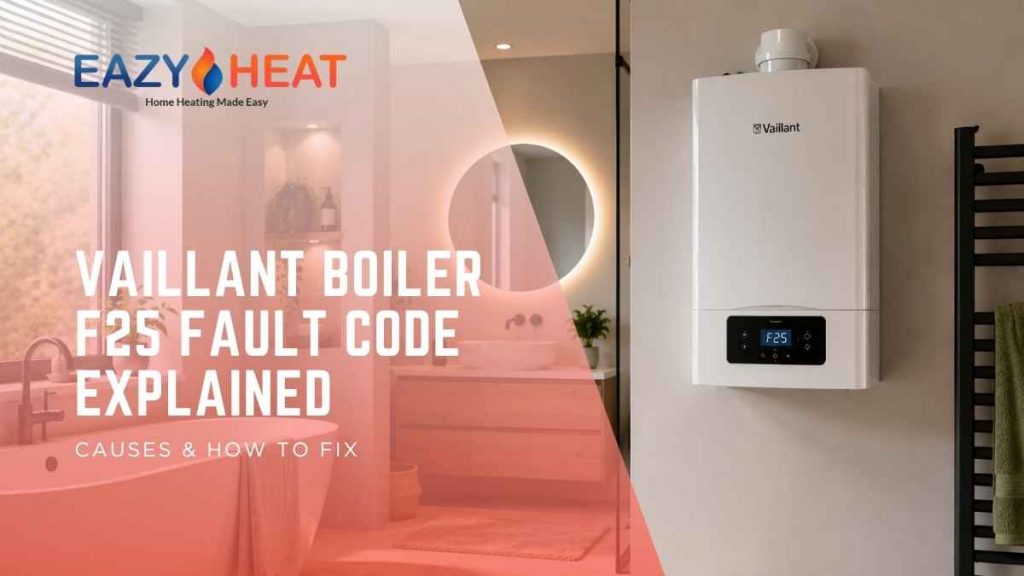

The Vaillant boiler F25 fault code means the flue gas temperature has risen too high and the boiler has switched itself off as a safety measure. In everyday terms, the hot gases leaving the boiler through the flue are hotter than they should be, usually because heat is not being carried away properly by the circulating water.
This is a protective lockout seen on many ecoTEC models in UK homes. Heating and hot water stop until the underlying problem is sorted.
What Does The Vaillant Boiler F25 Fault Code Mean?
The Vaillant boiler F25 fault code means the flue gas temperature is too high. Your boiler monitors the temperature of the exhaust gases. When that reading exceeds the safe limit the control board shuts the burner down to protect the heat exchanger and other parts.
Official Vaillant guidance links the code to circulation problems, a defective wiring harness or the flue gas temperature monitor itself having triggered. You may notice the boiler locks out during a heating demand and will not restart until the cause is fixed and the system is reset by an engineer in many cases.
Understanding this helps you know why the appliance is protecting itself and what to check next.
What Causes The F25 Fault Code On Your Vaillant Boiler?
The F25 fault code on your Vaillant boiler is usually caused by heat not being removed fast enough from the heat exchanger, which drives the flue gas temperature up. The most common reasons are poor water circulation from sludge or blockages, a weak or seized pump, trapped air or low system pressure, and problems with the flue gas temperature sensor or its wiring.
These issues appear regularly on older systems or boilers that have not been serviced. Below we explain each main cause in plain language and give practical steps to put things right. Gas and internal boiler work must always be left to a Gas Safe registered engineer.
Blocked Or Sludge Filled Heating System
A blocked or sludge-filled heating system is one of the top reasons for the F25 error code. Over the years black iron oxide sludge and limescale collect inside radiators, pipes and the primary heat exchanger. This restricts water flow so the water that does pass through the boiler heats up very quickly.
The excess heat then appears as high flue gas temperature and the safety monitor trips. You may see cold spots at the bottom of radiators, hear kettling noises, or notice the system takes longer than usual to warm the house. Hard-water areas and systems that have never been power-flushed are especially prone to this.
How To Fix
- Check radiators for cold spots at the bottom while the heating is calling for heat. This often points to sludge.
- Bleed the radiators carefully to release any obvious air and see if dirty water appears.
- Arrange a professional power flush with a Gas Safe engineer. The engineer uses specialist equipment and chemicals to clear the system thoroughly.
- After the flush ask for a quality inhibitor to be added and a magnetic filter fitted if one is not already present.
- Book an annual service so the system stays clean and the risk of future F25 lockouts is reduced.
A typical power flush in the UK costs between £350 and £800 depending on the size of the property and how dirty the system is.
Faulty Or Seized Circulating Pump
A faulty or seized circulating pump frequently causes the F25 fault. The pump moves hot water around the radiators and back to the boiler. If it runs too slowly, sticks or fails completely, heat stays trapped in the heat exchanger. The flue gases then become too hot and the safety switch-off occurs.
You might hear unusual humming or grinding from the boiler cupboard, notice uneven heating across the house, or find the fault appears mainly when the heating demand is high. Pumps wear out over time, especially in systems that contain sludge.
How To Fix
- Listen near the boiler when the heating tries to start. Strange noises can indicate a struggling pump.
- Make sure all radiator valves and any isolation valves under the boiler are fully open.
- Check the system pressure is between 1.0 and 1.5 bar when the system is cold.
- Call a Gas Safe registered engineer. They will test the pump, check its speed setting and replace it if necessary.
- Ask the engineer to confirm the rest of the system is free of blockages at the same time.
Pump replacement typically forms part of the average UK boiler repair cost of around £300, though parts and labour can vary by region.
Trapped Air Or Low System Pressure
Trapped air or low system pressure can trigger the F25 code. Airlocks stop water circulating freely so localised hot spots form inside the boiler. Low pressure (usually below 1.0 bar) has a similar effect because there is simply not enough water to carry the heat away. Both situations allow the flue gas temperature to climb rapidly.
You may hear gurgling from radiators or pipes, see the pressure gauge sitting low, or notice that some radiators stay cold at the top.
How To Fix
- Turn the heating off and allow the system to cool completely.
- Bleed every radiator starting from the lowest floor and working upwards, using a radiator key and a cloth to catch water.
- Check the boiler pressure gauge. Top it up carefully to between 1.0 and 1.5 bar using the filling loop if the reading is low, following the instructions in your handbook.
- Restart the boiler and see whether the F25 clears.
- If the pressure drops again quickly or the fault returns, contact a Gas Safe engineer. They can check for ongoing leaks or larger airlocks inside the boiler.
Faulty Flue Gas Temperature Sensor Or Wiring
A faulty flue gas temperature sensor or damaged wiring can cause the F25 error even when circulation is good. The sensor tells the control board the exact temperature of the exhaust gases. If the sensor fails, the wiring becomes loose or corroded, or the monitor itself trips, the boiler receives a false high reading and shuts down.
This is less common than circulation problems but still appears on boilers that have suffered from overheating in the past or have not been serviced regularly.
How To Fix
- Do not open the boiler casing yourself. That work is for qualified people only.
- Note whether the fault appears at the same point in the heating cycle each time.
- Call a Gas Safe registered engineer who is familiar with Vaillant boilers.
- The engineer will test the flue gas temperature sensor, inspect the wiring harness and replace any defective parts.
- After the repair they will carry out a full combustion check to confirm the boiler is operating safely.
How Can You Prevent The Vaillant Boiler F25 Fault Code In Future?
Preventing the F25 fault code starts with regular care of the whole heating system. Book an annual Gas Safe service so an engineer can check the pump, sensors, pressure and inhibitor levels.
Fit a magnetic filter if you do not already have one. This catches sludge before it reaches the boiler. Bleed radiators whenever you notice cold spots or gurgling. Keep system pressure in the correct range and avoid letting the system sit unused for long periods without an inhibitor.
These simple habits keep water flowing freely and reduce the chance of flue gas temperatures rising too high.
Is It Time to Replace Your Vaillant Boiler?
If your Vaillant boiler keeps showing the F25 fault code, recurring overheating and circulation problems can be a sign that the appliance is becoming unreliable. While repairing individual components may restore your heating temporarily, repeated breakdowns often mean higher repair costs, more disruption, and reduced efficiency. Replacing an ageing boiler with a modern, energy-efficient model can provide dependable performance and lower running costs for years to come.
At Eazy Heat, we make boiler replacement straightforward for homeowners and landlords across the UK. Our experienced Gas Safe registered engineers provide a fast, customer-focused installation service, and every new boiler is backed by a market-leading 12-year parts and labour warranty for complete peace of mind.
With our simple online boiler quotation tool, you can receive a fixed-price quote in just a few minutes and book your installation without the hassle of lengthy home surveys or hidden costs.
If your Vaillant boiler is repeatedly locking out with the F25 fault code, get your free online boiler quote today and discover how easy it is to upgrade to a reliable, energy-efficient heating system with Eazy Heat.
FAQs
Is the Vaillant boiler F25 fault code the same as the F24 code?
No. F24 usually means the flow temperature is rising too quickly (an early warning of circulation problems). F25 is the full safety switch-off because the flue gas temperature has already become too high. The two codes are related but F25 is the more serious lockout.
Can low outside temperatures make the F25 code more likely?
Cold weather itself does not directly cause F25, but it can highlight existing circulation problems because the boiler works harder. A frozen condensate pipe is more often linked to ignition faults such as F28 rather than F25.
Does a landlord have to act quickly if a tenant reports the Vaillant boiler F25 fault code?
Yes. Landlords must keep the heating system in safe working order under UK law. An F25 lockout leaves the property without heat, so prompt attendance by a Gas Safe engineer is required. Keep clear records of every call-out and repair.
Will a magnetic filter stop the F25 code coming back?
A magnetic filter helps catch metal particles and sludge before they reach the boiler and pump. It greatly reduces the chance of future circulation problems when combined with a clean system and inhibitor, but it cannot fix an already failed pump or sensor on its own.
How long does a typical repair for the Vaillant boiler F25 fault code take?
Most straightforward cases (pump replacement or sensor change) are completed in a single visit of one to three hours once the engineer is on site. A full power flush takes longer, often a full day depending on the size of the system.